.png)
Wind farm operations generate enormous amounts of data. Inspection findings, work orders, defect reports, subassembly histories, and maintenance records. Volume is never the problem. The problem is whether that data is attached to the right thing.
For most operators, that connection is still relatively flat. Assets are often managed primarily at turbine level, with limited structure beneath them. A turbine number, a work order history, a status field, maybe a few notes or linked documents. It works at first, but as fleets grow and maintenance history expands, the limitations become harder to ignore.
When the pattern is right there but invisible
A blade bearing fails on WTG 14. A work order goes out, the repair gets completed, and the ticket closes. A few months later, the same failure appears on WTG 31 during a routine inspection. Then again on WTG 07 after another technician reports similar wear patterns. Individually, these look like isolated turbine level events.
In the system, these look like three separate turbine level events. Nobody connects them because the system has no concept of the subassembly they share.
This is the hidden cost of a flat asset list. The pattern was always there. The structure to surface it was not.
When assets are tracked at the function and component level, from site to turbine to parent subassembly to child subassembly, faults stop being isolated incidents and start becoming signals.
The same bearing model failing across a fleet is no longer invisible. It becomes a procurement decision, a manufacturer conversation, or a proactive replacement campaign across 30 machines instead of 30 reactive callouts.
Nested level asset structure is what allows operators to move from reacting to individual failures toward identifying patterns across the fleet before they become larger operational issues.
A work order is only as good as the asset it's attached to
The consequences of flat asset tracking do not stop at fault analysis. They appear every time a technician opens a work order in the field.
A work order attached to “WTG 14” says that technicians are almost nothing useful. Which system? Which subassembly? What was done last time someone was up there? What parts are likely needed?
Without a nested subassembly level asset context, a work order becomes little more than a location and a problem description. The technician fills the rest from memory or experience, if they have it.
A work order attached to “WTG 14 > Drivetrain > Main Bearing > Input Seal” is a completely different document. It carries history. It connects to previous visits, findings, and repairs. It gives technicians the context they need before arriving onsite.
Work order quality is directly connected to asset structure quality. Wasted site visits, incorrect parts, and repeat failures that could have been avoided are often rooted in how asset data is structured and connected.
Health means different things at different levels
Ask three different people in a wind organisation what a “healthy” asset looks like and you will probably get three different answers.
An asset manager may talk about availability, downtime, and predictable costs. A site manager is more likely to focus on production figures, weather corrected performance curves, and turbine rankings. For a technician, health often comes down to inspection findings on a specific gearbox or component.
None of these views are wrong. They are simply answers to different questions being asked at different levels of the hierarchy.
Operators working with flat asset lists are often limited to a single level of visibility regardless of the decision in front of them. A portfolio review requires aggregation that is not there. A subassembly inspection requires granularity that is not there either.
Teams end up exporting data, building their own pivot tables, and manually translating between levels that should already connect naturally.
When the asset model has structure, health metrics begin to match the question being asked. Availability rolls up naturally from component to turbine to site to portfolio. Inspection findings stay connected to the component level where they belong. A single platform view can move between levels without losing context.
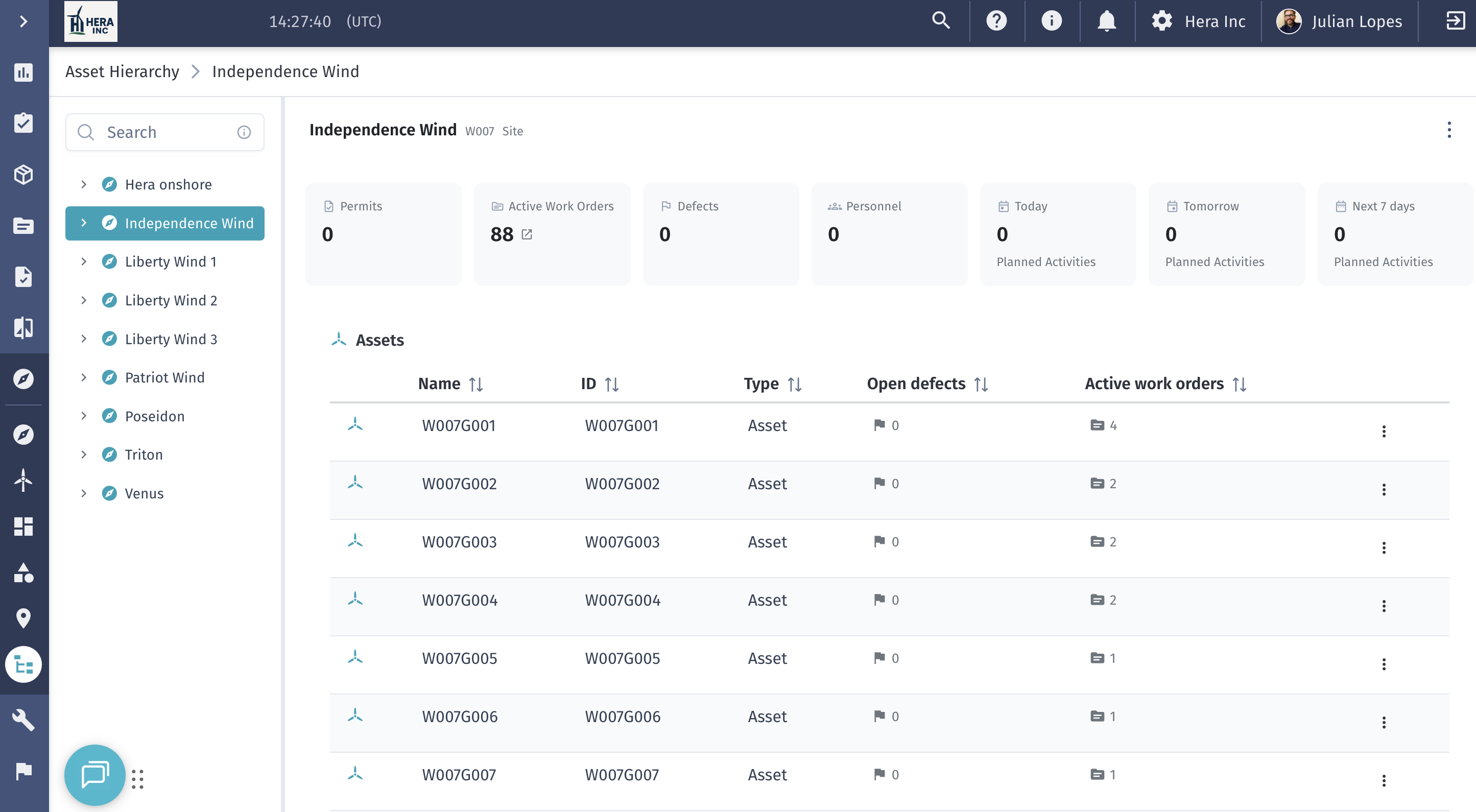
Introducing the new Asset Hierarchy in Shoreline
Shoreline’s improved Asset Hierarchy visualisation and navigation experience was designed around these exact operational challenges, helping operators move beyond flat asset lists and work with asset data in a more connected across the platform.
The new hierarchy gives operators a structured and navigable view of their asset estate, from portfolio level down to individual functions and components.
Faults, work orders, defects, inspection records, and maintenance history attach to the right level of the hierarchy instead of being isolated at turbine level. Patterns become visible across assets of the same type. Work orders carry richer component context into the field. And health metrics adapt to the level being viewed, whether that is a portfolio summary or a technician preparing a maintenance visit.
Navigation has also been redesigned to move fluidly between levels. Users can start at the portfolio, drill into a site, move into a turbine, and follow the hierarchy down to a specific component while maintaining full visibility into history, open work orders, and linked defects throughout the process.
For onshore and offshore fleets alike, the asset list has always been the lens through which O&M data is interpreted. Shoreline’s new Asset Hierarchy makes that lens significantly sharper.
Want to see the new Asset Hierarchy in action? Book a demo today.