
Recently, we introduced a set of improvements across the Shoreline Platform to better connect planning and execution. The challenge is not just creating a plan, but understanding how it evolves, how work progresses in the field, and how everything comes together in real time.
These updates make it easier to see what is happening across your operations and what needs attention, so teams can spend less time figuring things out and more time moving work forward.
If you are a planner in wind operations, you know this moment well.
You open the Planning Board to understand where things stand and answer a simple question. Are we on track? Not just what is scheduled, but what changed, what slipped, what is at risk. Instead of getting a clear answer, you end up stitching the story together yourself.
This is where the gaps become real. Between what was planned, what is happening, and what is actually visible.
Small changes on their own. A big difference when everything comes together.
When Plans Change but Visibility Is Lost
Let’s take a real scenario. A turbine requires corrective work identified during an inspection. A work order is created, a checklist is attached, and a technician is scheduled for next week.
Then things shift. Weather delays the job. Another task is added to the same asset. The plan evolves, as it always does.
The problem is not that plans change. It is that teams are not aware of those changes when they happen.
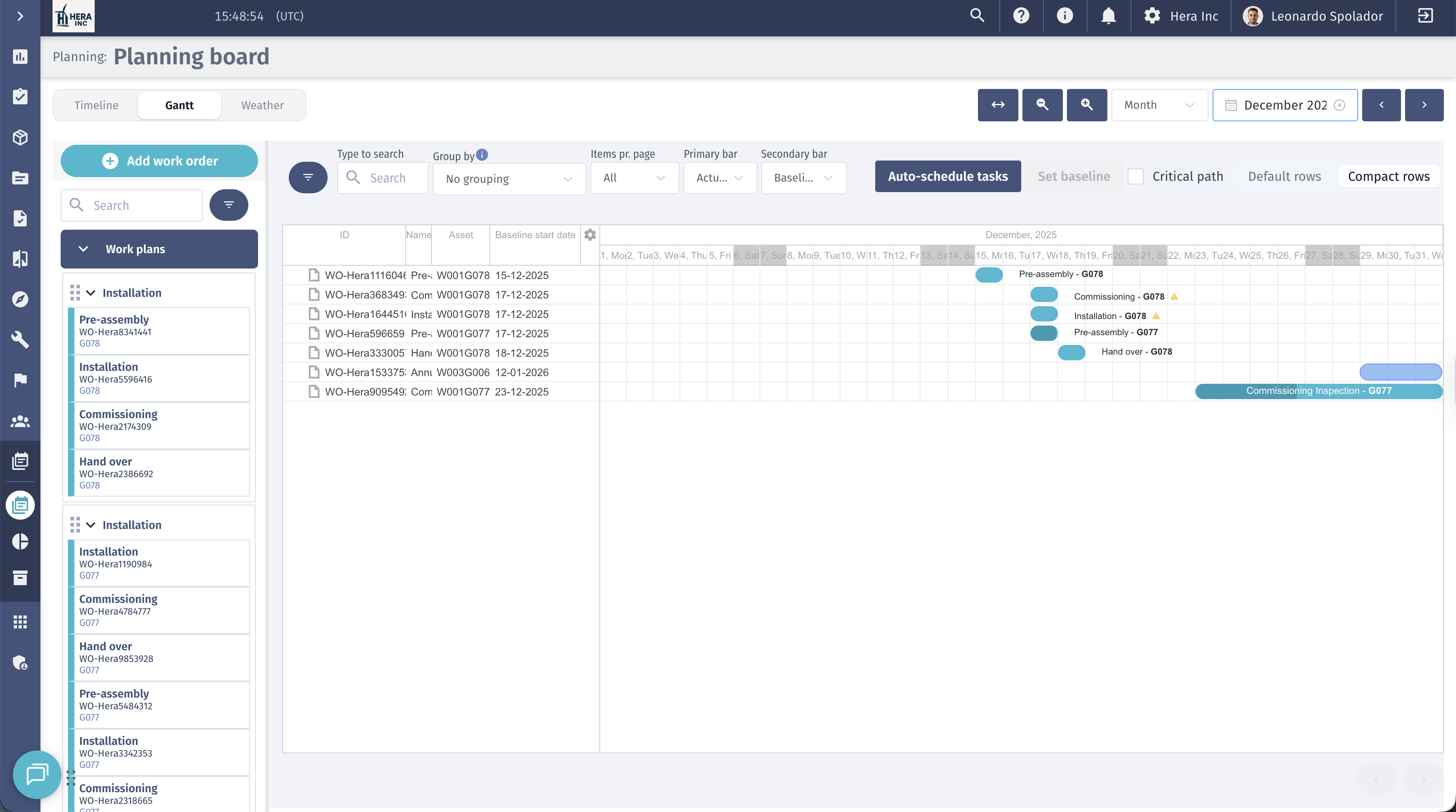
With planned start and end dates directly on the work order, and the ability to compare planned versus baseline in the Planning Board, that gap disappears. You can immediately see what was originally expected and what is currently planned, without having to reconstruct it manually.
Planning becomes easier to trust because the story is already there.

Scaling Planning Without Losing the Overview
As operations grow, so does the volume of work. More assets, more teams, more overlapping activities.
But most tools were not designed to handle that scale comfortably. You scroll, you zoom, you lose context.
With adjustable row density and expanded Timeline and Gantt views, you can see significantly more work at once. Whether you need a high-level overview or a detailed view, the interface adapts to your workflow. Less scrolling, more understanding.
Seeing Conflicts Before They Become Problems
When multiple activities happen on the same asset or within the same work plan, conflicts are inevitable. The challenge is spotting them early enough.
By grouping the Gantt chart by asset or by work plan, you can immediately understand how work is distributed and where overlaps occur. Instead of reacting to conflicts after they happen, you can prevent them during planning.
This is where planning shifts from coordination to control. And once the plan is clear and aligned, the focus shifts to execution and keeping work moving.
Closing Work Shouldn’t Slow You Down
Even when the work is complete, closing it can become another bottleneck.
Selecting work orders one by one, sending approvals individually, repeating the same steps over and over.
With bulk closing, multiple work orders can be sent for approval in a single action, while keeping the same approval flow and full traceability.
The process stays controlled, but execution moves faster.
The Small Details That Make a Big Difference
Not every improvement is a headline feature, but they all matter.
Being able to resize columns, adjust layouts, and make better use of available space improves how quickly you can read and act. These small changes reduce friction in ways that are felt every day, especially in high volume environments.
A More Connected Way to Operate
Planning, execution, and tracking have traditionally lived in separate steps. That separation creates gaps. And those gaps create friction.
These updates are designed to bring those steps into one continuous flow.
You can see how plans evolve. You can trust the progress you are looking at. And you can move work forward without unnecessary effort.
If you recognize the feeling of piecing everything together just to understand what is going on, this is exactly what we set out to solve.
Book a demonstration to see how Shoreline connects planning and execution in one flow, and how it can transform the way your team operates.